


Could you afford to be out of work for seven years?
Most of us rely on our monthly income to keep life moving. It pays the mortgage or rent, covers household bills, puts food on the table and helps us plan for the future.
But have you ever considered what would happen if illness or injury prevented you from working for an extended period?
For many people, the immediate assumption is that they would be out of work for a few weeks or months. However, new research highlighted in Aviva Life & Pensions Ireland’s report, The 7 Year Shock, suggests that the financial consequences of being unable to work could last considerably longer than many households expect.
According to Aviva’s Income Protection claims data, the average claim in 2025 lasted 7.8 years.
That’s almost eight years of potentially reduced earnings, while everyday financial commitments continue.
The report, written by economist Jim Power and published in October 2026, examines whether Irish households are financially prepared for a prolonged loss of income. Its findings raise important questions about savings, State supports, household finances and the role of Income Protection.
Protection Insurance
Compare Protection Insurance options from a range of leading providers, with personal advice from an Emero adviser.
Prefer to Speak to Us?
Have a question or prefer to speak to an adviser? Give us a call or WhatsApp us.
How quickly could you feel the financial pressure?
One of the most striking findings in the report is how quickly households could experience financial difficulty if their regular income disappeared.
Research conducted by 3Gem Research & Insights on behalf of Aviva, surveying 1,000 workers in Ireland, found:
55% would experience financial pressure immediately or within three months of losing their income.
72% have less than four months’ worth of essential living expenses saved.
13% have no savings at all.
60% do not feel financially prepared for a prolonged loss of income.
89% would worry about their finances if they were unable to work for more than six months.
64% do not currently have Income Protection insurance.
These findings highlight a potential gap between how much we depend on our income and how prepared we are to replace it if we can no longer work.
Having some savings is certainly helpful, but savings are generally designed to provide a financial cushion rather than replace years of lost earnings.
How long could Irish households maintain their lifestyle?
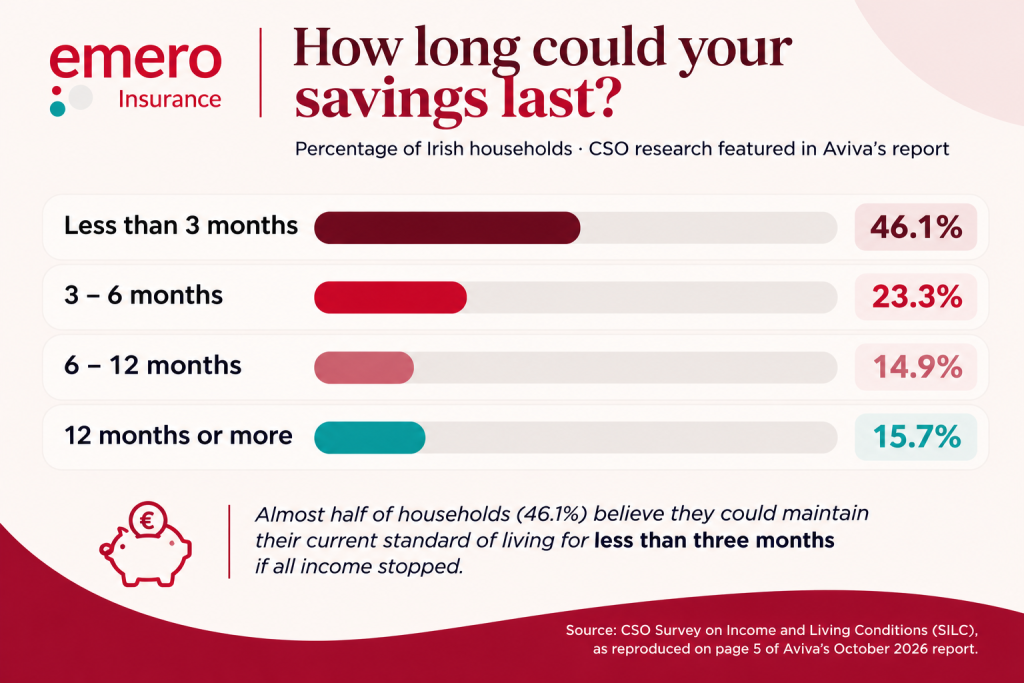
The report also draws on the Central Statistics Office’s Survey on Income and Living Conditions (SILC) to examine how long households believe they could maintain their current standard of living using savings alone if all income stopped.
The findings are particularly interesting:
| How long households could manage | Percentage |
|---|---|
| Less than 3 months | 46.1% |
| 3 to 6 months | 23.3% |
| 6 to 12 months | 14.9% |
| 12 months or more | 15.7% |
Almost half of households surveyed believed they could maintain their current standard of living for less than three months.
This illustrates just how dependent many households are on receiving a regular income.
What happens when you lose your income?
If illness or injury prevents you from working, there are a number of potential sources of financial support. However, these may not replace your normal salary.
The Aviva report examines the role of employer sick pay, State supports and personal savings.
Statutory sick pay
Under the arrangements outlined in the report, eligible employees are entitled to five days of statutory sick pay per year.
This is paid at 70% of normal daily earnings, up to a maximum of €110 per day.
While this can help with an initial absence from work, five days of statutory sick pay is unlikely to provide long-term financial security if an illness or injury keeps someone out of work for months or years.
Illness Benefit
Employees who meet the relevant PRSI contribution requirements may qualify for Illness Benefit through the Department of Social Protection.
At the time of the report, the maximum payment was €254 per week, depending on average weekly earnings. It can be paid for up to 104 weeks, subject to eligibility and contribution requirements.
For someone accustomed to receiving a regular monthly salary, a payment of this level could represent a significant reduction in household income.
Personal savings
Savings can provide an important financial buffer during an illness or injury. However, the report highlights how quickly those savings could be used when someone is facing ongoing household expenses without their usual earnings.
Mortgage repayments, rent, electricity, groceries, transport and childcare costs do not simply disappear when someone becomes unable to work.
For many households, savings may help manage the initial financial shock, but replacing several years of lost income is a very different challenge.
What would a prolonged absence from work look like?
To demonstrate how a long-term loss of income could affect different people, Aviva includes several illustrative case studies.
These examples examine different occupations, salaries, savings levels and employer sick pay arrangements.
The figures are not predictions of what would happen to every individual, but they help demonstrate how financial pressure can build over time.

Case Study 1: A tradesperson earning €60,000 p/a
Aviva’s example considers a skilled tradesperson working in the private sector.
The individual has:
Gross annual income of €60,000.
Net annual income of €48,000.
Mortgage of €210,000.
Savings of €40,000.
Annual household expenditure of €34,800.
Once statutory sick pay ends, the individual becomes heavily reliant on State Illness Benefit.
The report estimates an annual financial shortfall of €35,265 in the first year, increasing to €36,257 in the second year.
Despite having €40,000 in savings, the report estimates that these savings would be exhausted early in Year 2 if spending remained unchanged.
This example highlights the financial vulnerability that can arise when employer sick pay arrangements are limited and a household becomes reliant on State supports.

Case Study 2: A teacher earning €65,395
The second example examines a teacher who becomes unable to work due to serious illness.
Unlike many private-sector workers, teachers may have access to more generous employer sick pay arrangements.
The report assumes six months of full pay followed by six months of half pay.
The individual has:
Gross annual salary of €65,395.
Net annual income of €52,320.
Mortgage of €228,882.
Savings of €20,000.
Annual household expenditure of €36,000.
Despite these relatively favourable sick pay arrangements, the financial impact becomes significant once employer support ends.
The report estimates a shortfall of €10,872 in Year 1, increasing to €38,640 in Year 2.
The individual’s €20,000 in savings would be largely exhausted during the second year.
This example demonstrates that even people with stronger employer sick pay arrangements can face significant financial pressure if they are unable to return to work for a prolonged period.
What is income protection and how can it help?
The findings of the report highlight why protecting your income deserves more attention when considering your overall financial security.
Income Protection insurance is designed to provide a regular monthly payment if you are unable to work due to illness or injury, subject to the terms and conditions of the policy.
Depending on the policy, it can typically replace up to 75% of normal earnings, less any applicable social welfare benefits.
Unlike Life Insurance, which provides a benefit in the event of death, or Specified Illness Cover, which can provide a lump sum following diagnosis of a specified condition, Income Protection focuses on replacing part of the income you would otherwise lose when you cannot work.
This can help towards everyday financial commitments such as:
Mortgage or rent repayments.
Household bills and living expenses.
Supporting your family.
Maintaining financial commitments.
Protecting your longer-term financial plans.
The amount of cover available, deferred period, policy expiry age and premium will depend on individual circumstances and the insurer’s underwriting requirements.
Income Protection will not be suitable or necessary for everyone. However, for people who rely heavily on their regular earnings to maintain their lifestyle and meet financial commitments, it is certainly worth understanding how it works.
Income protection Insurance
Compare Income protection Insurance options from a range of leading providers, with personal advice from an Emero adviser.
Prefer to Speak to Us?
Have a question or prefer to speak to an adviser? Give us a call or WhatsApp us.
Source: Jim Power, The 7 Year Shock: Are Irish households prepared for a long-term income hit? Aviva Life & Pensions Ireland, October 2026. Research findings and illustrative case studies are reproduced in summary form. Individual circumstances and insurance policy terms vary. Income Protection is subject to underwriting, policy definitions, exclusions, limitations and conditions.