


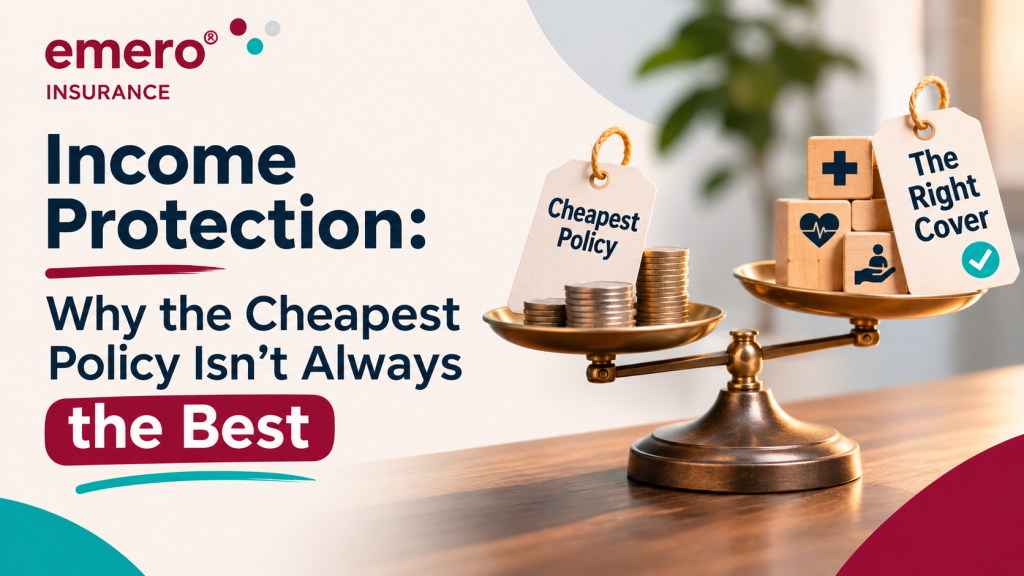
Income Protection: Why the Cheapest Policy Isn't Always the Best
When comparing Income Protection policies, it’s natural to focus on the monthly premium. Nobody wants to pay more than they need to, particularly when managing a mortgage, household bills and other financial commitments.
But is the cheapest policy necessarily the best one?
Income Protection is one of the most important forms of financial protection you can consider. It is designed to replace part of your income if illness or injury prevents you from working. Depending on your circumstances and policy, it could provide financial support for many years.
That’s why choosing a policy shouldn’t simply come down to finding the lowest monthly premium. It should be about understanding the protection you’re putting in place, the benefits included and the support available if you ever need to make a claim.
Income Protection Insurance
Compare Income Protection Insurance options from a range of leading providers, with personal advice from an Emero adviser.
Prefer to Speak to Us?
Have a question or prefer to speak to an adviser? Give us a call or WhatsApp us.
Think beyond the monthly premium
Imagine you’re working with an investment adviser. You wouldn’t necessarily expect them to recommend an investment simply because it has the lowest initial cost.
You would expect them to consider your financial goals, the level of risk involved, your timeframe and whether the investment is suitable for your circumstances.
Income Protection deserves a similar level of consideration.
You’re making a decision about protecting your future earnings. The difference between two policies might only be a few euro each month, but the benefits, definitions and additional services available could be considerably different.
A cheaper policy isn’t automatically a bad policy, just as a more expensive one isn’t automatically better. What matters is whether the cover is appropriate for you.
What should you actually be comparing?
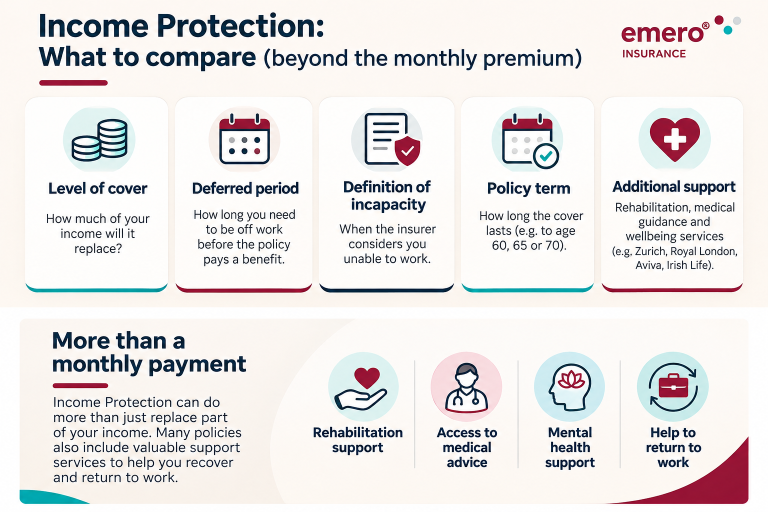
There are several important factors to consider when comparing Income Protection quotes.
1. How much income will the policy replace?
Most Income Protection policies allow you to insure a percentage of your earnings, subject to the insurer’s limits and assessment of your income.
Consider whether the monthly benefit would realistically help you maintain your mortgage repayments, household bills and everyday living expenses.
The objective isn’t necessarily to insure the maximum amount available. It’s to establish how much financial support you would actually need.
2. The deferred period
The deferred period is the amount of time you must be unable to work before your policy begins paying a benefit.
Depending on the insurer, you may be able to choose from a range of waiting periods.
If your employer provides six months of sick pay, for example, a longer deferred period might be worth considering. However, if you have little or no employer sick pay, a shorter period may be more appropriate.
The important thing is to make sure your chosen deferred period reflects your existing financial arrangements.
3. The definition of incapacity
This is one of the most important parts of an Income Protection policy.
You should understand the circumstances in which the insurer considers you unable to work and what definition of incapacity applies.
For example, some policies provide cover based on your ability to perform your own occupation, while others may have different definitions and conditions.
The wording can make a significant difference when you come to claim.
4. How long does the cover last?
Consider the age at which your policy expires and how long you might need financial protection.
A policy ending at age 60 will provide a different level of long-term protection to one that continues until age 65 or 70.
5. What additional support is available?
This is an area that can easily be overlooked when comparing premiums.
Income Protection isn’t necessarily just about receiving a monthly payment. Some insurers also provide additional services designed to support customers through illness, treatment and recovery.
These benefits can be particularly important because the financial impact of an illness or injury is only one part of the experience. Access to rehabilitation, medical guidance and emotional support may also make a meaningful difference.
What additional support do different insurers offer?
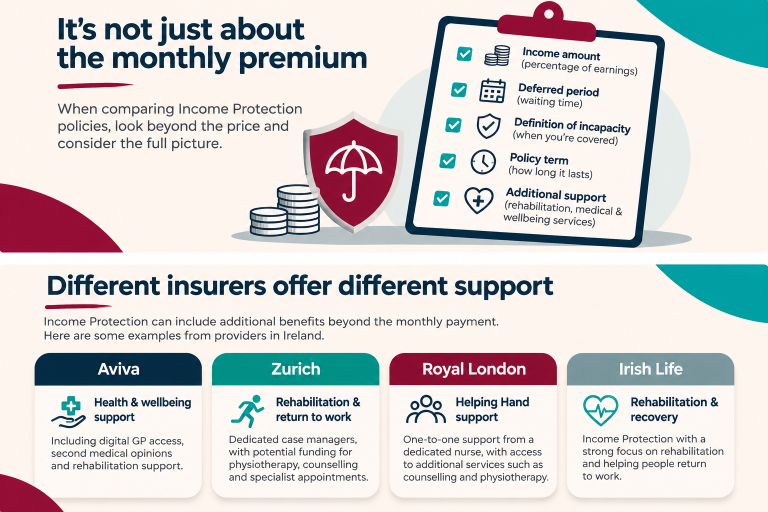
Different providers have developed their own support services and additional benefits. These are worth considering when comparing policies because the level and type of support can vary.
Here are some examples available from providers in the Irish market.
Aviva – Support through different stages of illness
Aviva offers additional services alongside its Income Protection offering, including Aviva Care.
Its support offering includes access to services such as digital GP appointments, Best Doctors Second Medical Opinion, Family Care Mental Health Support and bereavement support.
Aviva also highlights rehabilitation and recovery-related support, including treatment and specialist services where appropriate.
The idea is to offer more than financial assistance alone, helping customers access additional support when dealing with health concerns and the challenges that can accompany illness or injury.
Zurich – Rehabilitation and returning to work
Zurich places particular emphasis on rehabilitation and helping customers return to work.
Its Income Protection offering includes access to dedicated rehabilitation case managers who specialise in early intervention. They can help put a plan in place to support recovery and a return to employment.
Zurich also outlines potential funding for treatment with local physiotherapists, psychologists or counsellors, arranged in conjunction with the customer’s GP. Specialist appointments may also be funded where appropriate.
Another feature worth considering is its proportionate payment benefit. If someone returns to work on a reduced salary, they may be eligible for a proportionate benefit payment, subject to the policy conditions.
This recognises that returning to work isn’t always an immediate return to normal hours or earnings.
Royal London – Helping Hand
Royal London’s Helping Hand service takes a slightly different approach, focusing on personal and emotional support.
Through its partnership with RedArc, eligible customers can access a dedicated nurse who provides one-to-one support during difficult circumstances, including serious illness, chronic health conditions, disability and bereavement.
The service can also support a customer’s spouse or partner and children.
Depending on an individual’s circumstances and a nurse’s assessment, additional specialist support may be available. Examples include bereavement counselling, speech and language therapy, second medical opinions and physiotherapy for certain serious health conditions.
One particularly interesting aspect is that Helping Hand is available from the start of an eligible policy, rather than only when making an Income Protection claim.
Royal London states that the service is available at no additional cost to eligible customers, although it can be amended or withdrawn.
Irish Life – Rehabilitation and recovery
Irish Life also provides Income Protection designed to offer a regular income when illness or injury prevents someone from working.
Its published Income Protection information explains the financial benefit, deferred periods, cover limits and the importance of choosing an appropriate level of protection.
Irish Life also has a substantial rehabilitation offering through its employer group Income Protection schemes. Its rehabilitation programmes cover areas including cancer recovery, back pain, mental health, chronic fatigue and other conditions.
The company reports that more than 700 people returned to work in 2024 with assistance from its rehabilitation and early intervention services.
It’s important to distinguish these employer group services from individual Income Protection policies, as the benefits and services available depend on the particular arrangement.
Nevertheless, it demonstrates the important role rehabilitation can play in supporting people through illness and their eventual return to work.
Provider examples are based on published information and are intended to illustrate the different types of additional support available. They are not a like-for-like comparison or a guarantee that every service will be available to every policyholder. Eligibility, policy terms and conditions apply.
Looking at the bigger picture
It’s easy to become focused on the monthly cost when comparing insurance quotes.
But consider what you’re actually trying to achieve.
You’re protecting the income that pays your mortgage, supports your family, funds your lifestyle and allows you to plan for the future.
If you were unable to work for an extended period, the financial consequences could be significant. Having appropriate Income Protection in place could make a considerable difference.
And when comparing policies, it is worth considering the support that may be available beyond the monthly payment itself.
What happens when you first become ill? Is rehabilitation support available? Can you access additional medical or psychological services? What happens if you can only return to work part-time?
These are all worthwhile questions to ask.
This doesn’t mean you should automatically choose the most expensive policy or pay for benefits you don’t need.
It means looking beyond the price and understanding the differences between the options available.
A policy that costs a little more but provides benefits that are genuinely valuable to your circumstances may represent better overall value than the cheapest option.
How Emero can help
At Emero, we believe choosing Income Protection should involve more than comparing a list of monthly premiums.
It’s about understanding your occupation, health, income, financial commitments and existing employee benefits.
We’ll take the time to discuss what you’re looking to protect, explain the differences between available policies and help you understand what each option offers.
Because the cheapest policy isn’t necessarily the one you want to rely on when life takes an unexpected turn.
Your income is worth protecting. Make sure you understand what you’re buying.
Get in touch with Emero to discuss your Income Protection options.
Personal advice. Protection tailored to you.
Explore Income Protection with Emero
Income Protection is subject to underwriting, policy definitions, exclusions, limitations and terms and conditions. Benefits and additional services vary between providers and policies. Individual circumstances will determine the suitability of cover.